BY JOVAN K
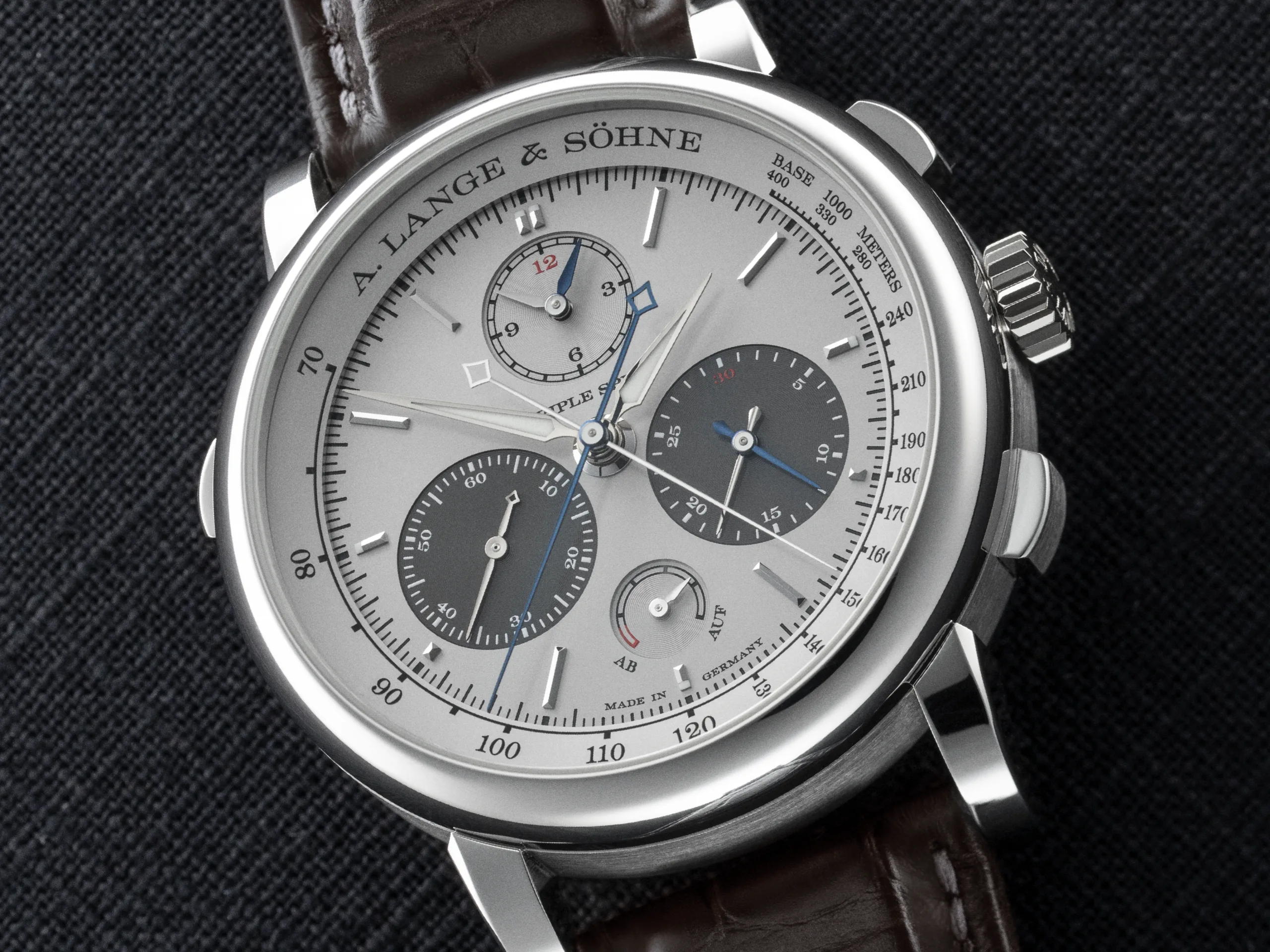
I have spent quite a bit of time with the earlier Saxonia Triple Split references, so when I finally got to see the new platinum 424.025F, I already knew what I was dealing. What I wasn’t expecting was just how different the watch would feel compared with the 18k white gold and pink gold versions. The basic architecture is familiar, but the combination of the 950 platinum case, rhodié dial, and darker grey sub-dials changes the character of the watch quite a bit, making it feel more serious and understated than the blue-dial pink gold version that has always been my personal favorite.

This is also one of those watches where the specifications don’t really tell you what the experience is like. At 43.2mm x 15.6mm, the Triple Split is clearly a substantial watch, and the platinum case adds another dimension to that because of the material’s density. You notice the weight immediately when you pick it up, but once it is actually secured on the wrist, the watch feels surprisingly well balanced. It has plenty of presence, but it doesn’t feel like the dimensions are there simply for the sake of making a statement.

The 950 platinum case is one of the things that makes this version particularly interesting when you have the earlier gold references to compare it with. Platinum has that cool appearance that can almost look like polished steel from certain angles, but the finishing makes it unmistakably Lange, with brushed surfaces sitting alongside sharply polished areas and carefully executed chamfers. The contrast is particularly nice on a case this large because there is enough surface area for the different finishes to catch the light as you move your wrist.

The crown is positioned at 3 o’clock, with the chronograph pushers at 2 and 4 o’clock and the dedicated split-seconds pusher at 10 o’clock. These are details you quickly stop thinking about when simply looking at the watch, but they become much more interesting once you start operating the chronograph. The pushers have the smooth, precise feel I have come to expect from Lange’s chronographs, with very little resistance and a distinct mechanical response when pressed. There is none of the vague feeling you sometimes get with complicated chronographs where the controls feel almost disconnected from what is happening inside the movement.
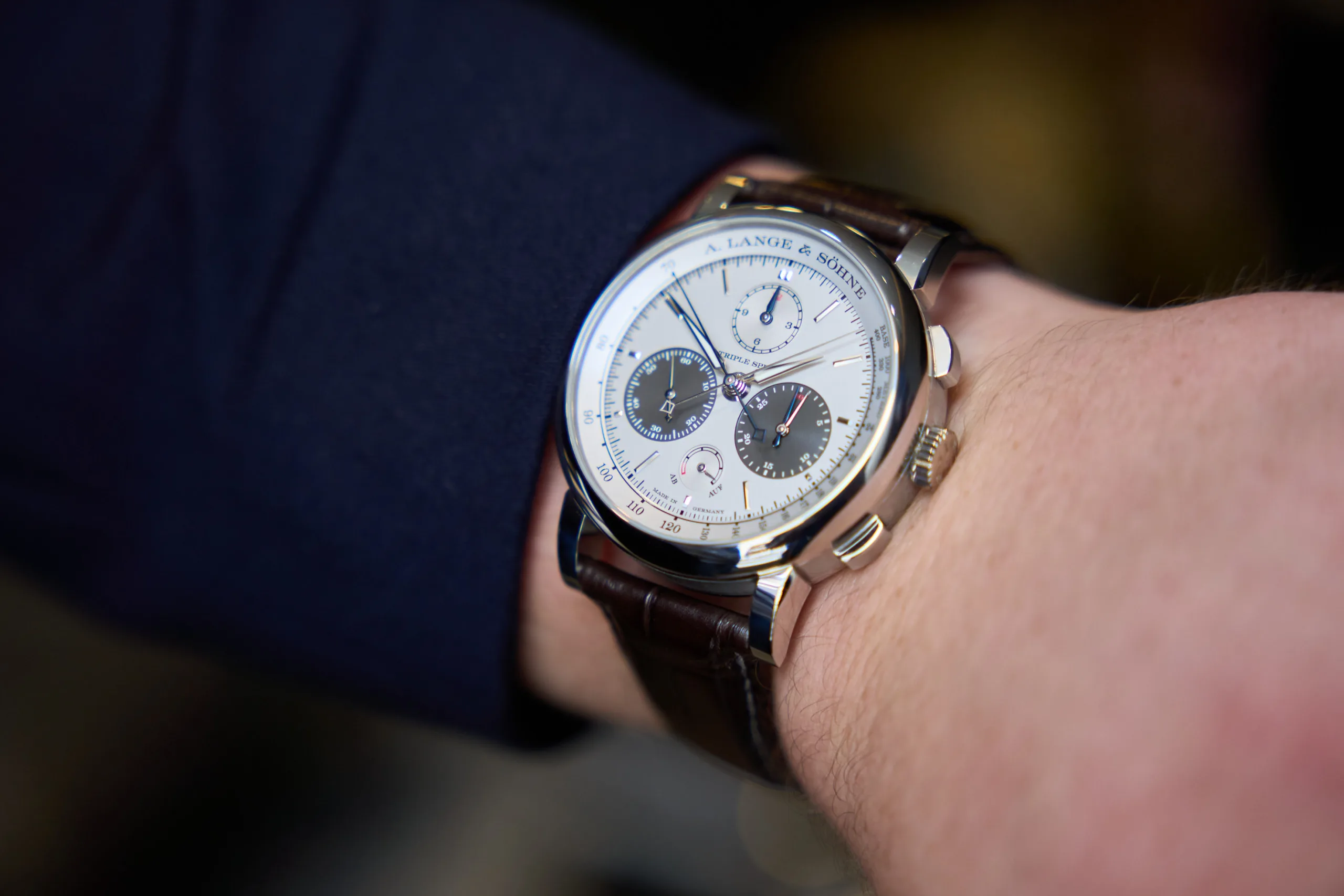
And then there is the weight. The gold Triple Split is already a substantial watch, but the platinum version takes that feeling considerably further. You know you are wearing something serious, although I find the weight less intrusive once the watch is on the wrist. The 30-meter water resistance is hardly surprising for a watch like this, and the sapphire caseback is where the real reason for buying a Triple Split becomes visible.
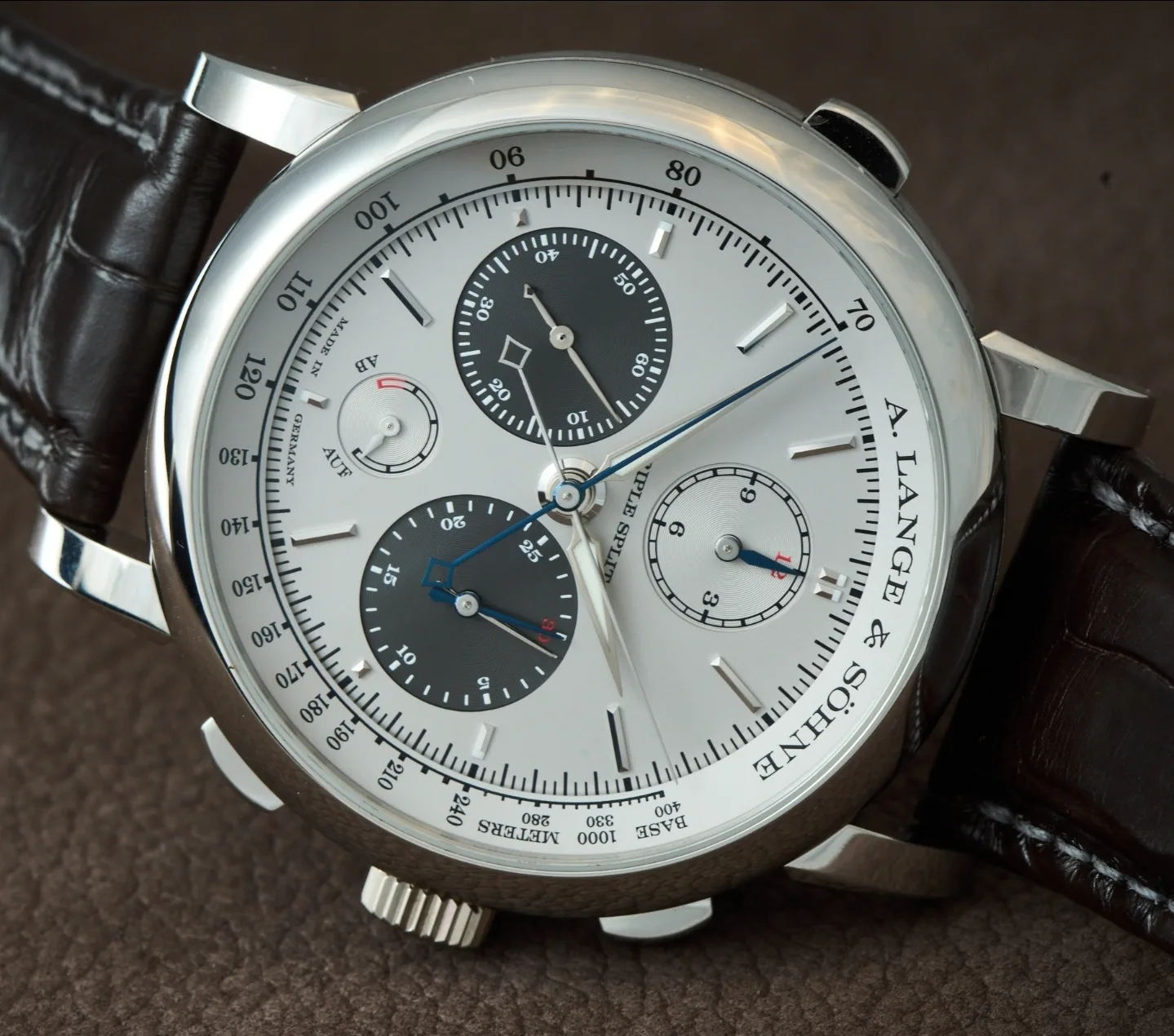
For me, the dial is where this new Triple Split becomes most interesting. When I first saw the platinum version, I wasn’t completely sure about the rhodié color. I had imagined something much more dramatic for the platinum case, perhaps an Azure blue dial, Onyx, or even a Lumen execution with contrasting silver sub-dials. Any of those combinations could have looked fantastic with the cold tone of platinum, and I think a more aggressive dial would have given the watch a very different personality.

I understand why Lange went in the opposite direction, as the rhodié-colored dial with the darker grey sub-dials is much more restrained, and it allows the case and the movement to do most of the talking rather than having the dial dominate everything. The different shades of grey give the dial plenty of depth, while the blued rattrapante hands add exactly the kind of color needed to stop the whole thing from becoming too monochromatic.
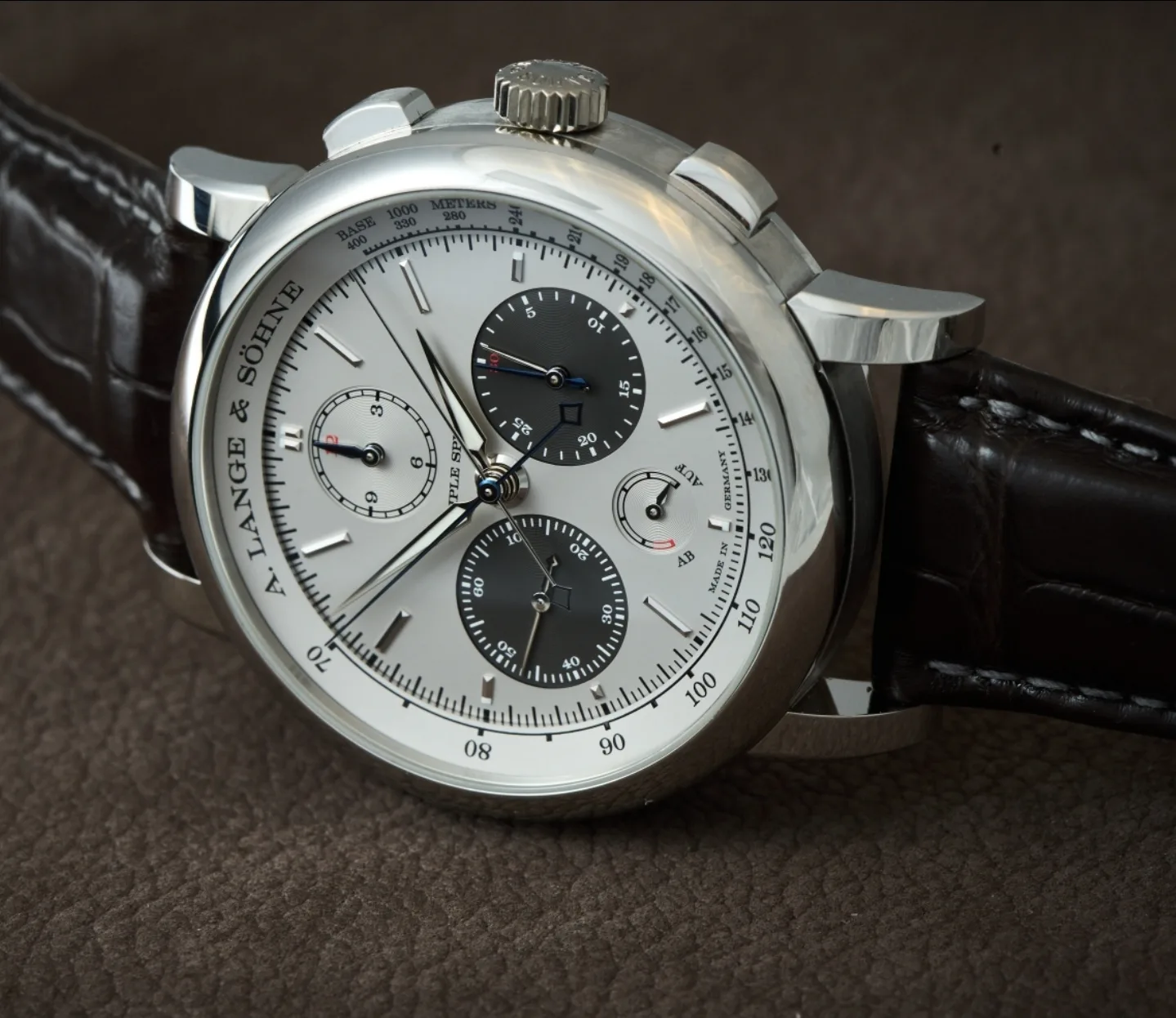
There is an enormous amount happening on the dial, but it doesn’t feel chaotic. The various scales and sub-dials are laid out in a way that makes the watch surprisingly easy to read once you have spent a little time with it, and the small red details add another layer without turning the dial into something overly colorful. The rhodium-gold appliques also pick up the light nicely through the sapphire crystal, which becomes particularly obvious when you move the watch around under different lighting.
One interesting detail is that Anthony de Haas, Lange’s Director of Product Development, considers this his favorite Triple Split configuration. I can understand the choice, even if the blue-dial pink gold reference remains the one I personally love.

Turn the watch over and the entire conversation changes. The manually wound L132.1 is still the main attraction, with its 30.6mm diameter and 9.4mm thickness helping explain why the case needs the dimensions it has. There are 567 individual components, 46 jewels and five screwed gold chatons, while the movement runs at 21,600 vibrations per hour and provides 55 hours of power reserve.

What makes the Triple Split so fascinating isn’t simply the number of parts or the amount of finishing, but what all those components are actually doing. The triple rattrapante system allows intermediate and comparative times to be measured from 1/6th of a second all the way to 12 hours, extending the split-seconds principle beyond the seconds hand to the minute and hour counters. There is also a flyback function, jumping minute counters, continuous hour counters, sub-seconds and a tachymeter scale.
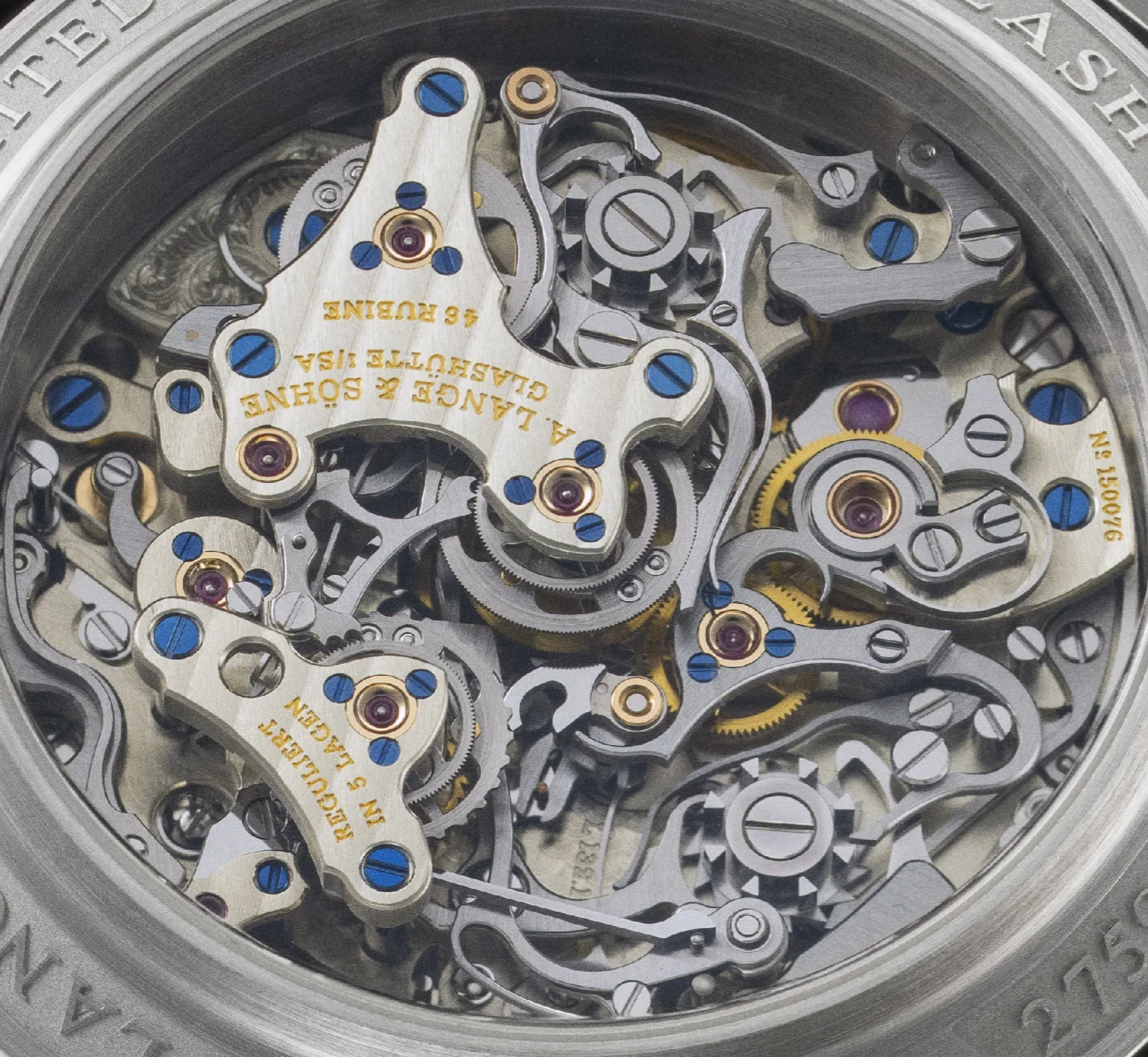
It is the kind of movement where you can look at it for several minutes and still find something else happening. The levers, springs, bridges and chronograph components create a very dense mechanical landscape, but Lange’s finishing keeps everything visually separated enough that you can actually follow the architecture. The untreated German silver bridges, Glashütte ribbing, hand-engraved balance cock, bevelled edges and polished internal angles are all familiar elements of Lange’s finishing language, but they become particularly impressive here because of how much mechanical hardware there is to finish.

You can list what the mechanism does, but that doesn’t really communicate what it is like to operate the chronograph and then turn the watch over and see the machinery responsible for it.

The platinum case is paired with a dark-brown hand-stitched alligator strap with grey stitching and a platinum deployant buckle. I think Lange made the right choice here because the brown introduces some warmth without fighting the cool combination of platinum, rhodié and grey on the front of the watch. A black strap would have made the whole thing even more severe, while the brown gives it just enough contrast to make the watch feel less clinical.
The new Saxonia Triple Split in platinum is limited to 100 pieces worldwide, with the price available on request, although you can expect it to be around €210,000.
I think what surprised me most is that it doesn’t simply feel like the existing watch placed into a more expensive case. The platinum changes the way the watch presents itself, and combined with the rhodié and grey dial, it gives the Triple Split a much quieter and more serious personality than the white and pink gold versions.

It is still a large watch; there is no getting around that, and the platinum case gives it plenty of weight, but neither really bothers me. If anything, the size makes more sense after you have spent some time looking at the L132.1 calibre through the caseback and appreciating just how much is packed inside. This isn’t a watch you buy because you need a chronograph; you buy it because you want one of the most technically ambitious mechanical chronographs Lange has ever made, and I think the platinum version gives that idea a very different and surprisingly appealing personality.
Explore more at A. Lange & Söhne