By Salim Hammad
A Brief History of the Perpetual Calendar
For a complication so intellectually satisfying, the perpetual calendar had a surprisingly slow burn into mainstream horology. It is easy to forget that for most of the 20th century, perpetual calendars were confined to a niche corner of watchmaking, mostly reserved for haute horlogerie dress watches. And it all started with the pocket watch.
The first known perpetual calendar mechanism dates back to 1762, credited to English watchmaker Thomas Mudge. Designed to account for the varying lengths of months and leap years, Mudge’s mechanism was a marvel of early mechanical programming. But it was cumbersome, delicate, and firmly anchored to the pocket. Wristwatches would not get their first taste of a perpetual calendar until 1925, when Patek Philippe retrofitted a ladies’ pendant watch movement into a wristwatch case and released the reference 97975. That piece now sits in the Patek Philippe Museum as the first perpetual calendar wristwatch in history.
The idea was audacious. A mechanical watch that could keep track of the date correctly for decades, without human input, until the year 2100, when the Gregorian calendar rules break down slightly. It could handle February 29. It could manage months with thirty or thirty-one days. It could keep ticking through all of it with quiet mechanical certainty. And it could do so in a package barely thicker than your thumb.
But it was not until the 1940s that perpetual calendars became a bit more wearable and serially produced. The Patek Philippe reference 1526 and later the 1518 (the first chronograph perpetual produced in series) defined the postwar dress perpetual. By the late 20th century, perpetual calendars had become a mark of technical maturity for any watchmaker wanting to sit at the top table. Lange, Audemars Piguet, Jaeger-LeCoultre, Blancpain, and IWC all got in the game, offering their own take on this once esoteric complication. (If you want more info about Patek Perpetuals – check out my article here).
But here’s the rub. Most perpetual calendars are big, expensive, and hard to wear. They often land in precious metals, over forty millimeters wide, or cost more than a car. I wanted to do something different. I wanted to find five perpetual calendars that are affordable, wearable, and, crucially, desirable to me as a collector.
So I set myself three rules:
- It had to be under £15,000 on the secondary market.
- It had to be wearable. Ideally, 40mm or under, no hulking pilot watches or wrist-bound dinner plates.
- It had to be attractive. Not just interesting on paper, but something I would happily wear.
With that in mind, here are five perpetual calendars that passed the test.
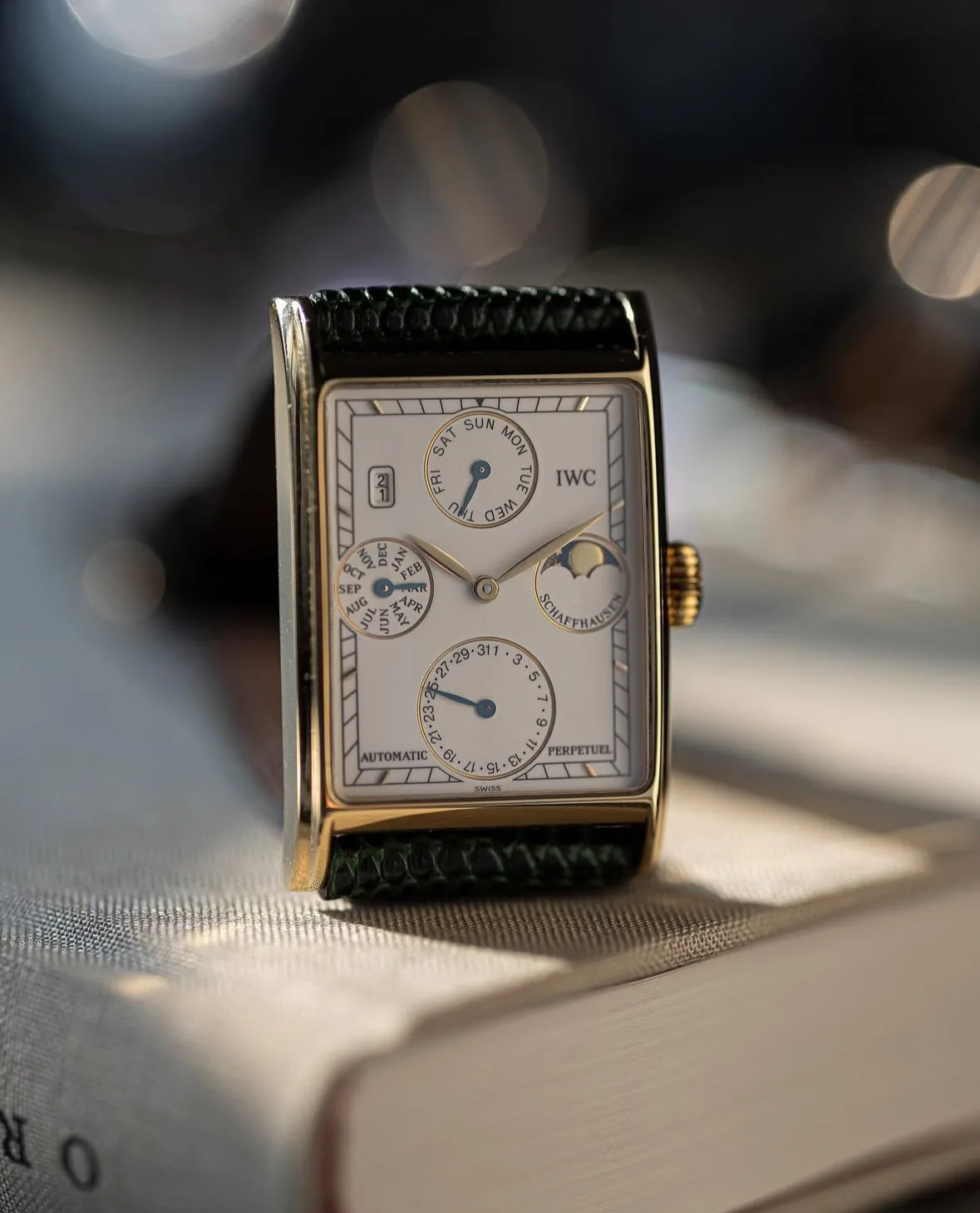
5. IWC Novecento Perpetual Calendar 3546 in Yellow Gold
Pic: @dunaliga
The IWC Novecento is perhaps the most quietly sophisticated perpetual calendar you can buy. Introduced in 1984, this was the first IWC to feature a perpetual calendar in a rectangular case, designed by none other than Kurt Klaus, the legendary IWC watchmaker responsible for simplifying the perpetual calendar interface.
The 3546 reference is the version that puts everything into balance. It’s slim, elegant, and sized at around 25mm x 35mm. That might sound small, but on the wrist, it wears much larger thanks to the rectangular format and long lugs. The dial shows the day, date, month, moonphase, and two-digit year in IWC’s signature layout, all controlled by a single crown. No hidden pushers or fiddly tools required.
Inside is a highly modified ETA 2892-A2 base with the perpetual module by Klaus stacked on top. It is not haute horlogerie in the traditional sense, but it is brilliantly functional, and it allows for a full perpetual calendar that is actually user-friendly. Prices hover between £6,000 and £9,000, depending on condition and whether the original strap and clasp are included.
Would I wear it? Absolutely. There is a bit of Cartier Tank energy here, mixed with Teutonic precision. It is rare to find a gold perpetual calendar that feels this understated.
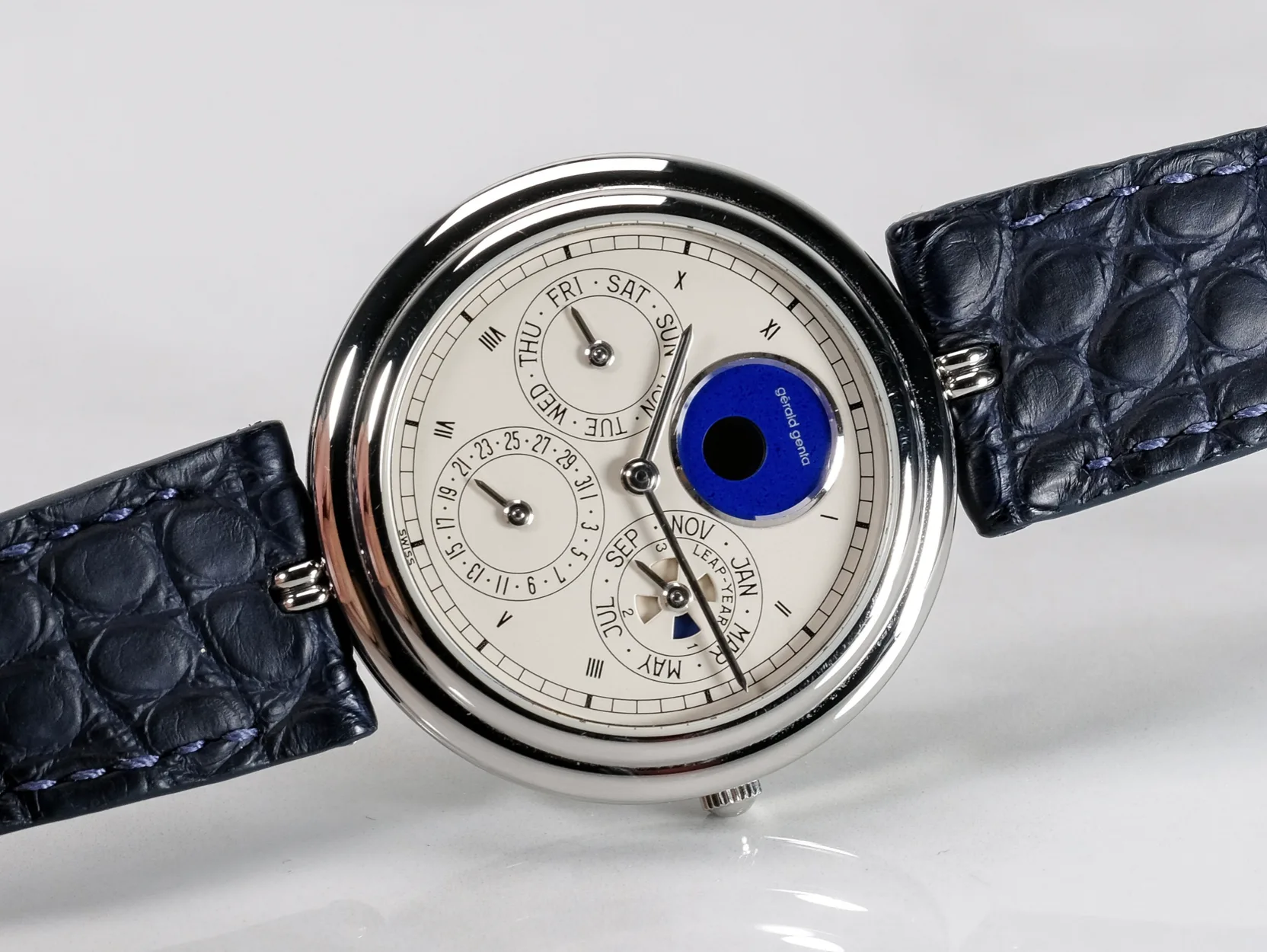
4. Gérald Genta Perpetual Calendar Ref. 2132 in Stainless Steel
Pic: Thillier Time
Most people associate Gérald Genta with bold, octagonal icons like the Royal Oak or Nautilus. But Genta also made incredibly complicated watches under his own name, and many of those pieces are hiding in plain sight on the secondary market.
The reference 2132 is a stainless steel perpetual calendar that often flies under the radar. It features a round 36mm case, a moonphase at six o’clock, and a delightfully busy dial with symmetrical subdials. The perpetual calendar layout is classic: day at nine, date at three, month and leap year at twelve. It is powered by a high-grade automatic movement, usually a modified base calibre like the Frédéric Piguet 71, and has lovely hand-finishing for the price point.
Best of all, you can sometimes find these for under £10,000. For a steel perpetual calendar from a legendary designer, that feels absurd. They are rare, yes, but not impossible to source.
Why would I wear it? Because it is a sleeper hit. Nobody expects the steel Genta perpetual. It looks like a vintage dress watch, but it punches way above its weight in both design pedigree and complication.
3. Blancpain Villeret Perpetual Calendar Ref. 6057-3642-55A

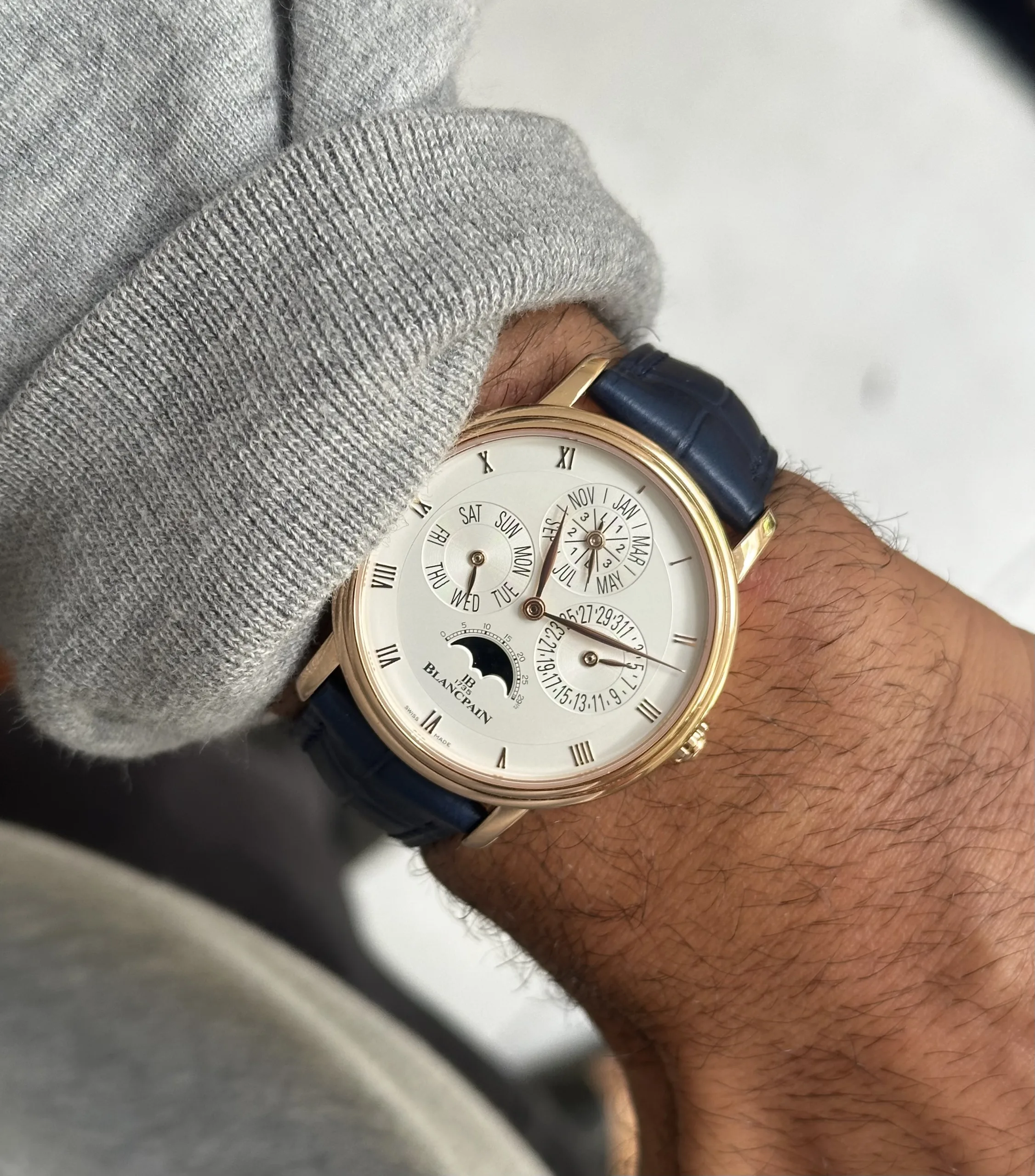
This is the most traditionally Swiss perpetual calendar on the list. If you want guilloché, moonphases with hand-painted moons, Roman numerals, and precious metal cases, Blancpain delivers it in spades. The 6057 is a rose gold perpetual calendar with one of the most useful features ever devised: hidden corrector pushers under the lugs.
Most perpetual calendars require a fiddly tool to adjust, and resetting one after it has stopped can be a headache. Blancpain solved this with patented under-lug correctors. They are invisible when worn but can be pushed with a fingernail to adjust the calendar functions. No tools needed, no scuffs on the case.
The 38mm case is perfectly sized, and the dial is quintessential Blancpain. It looks like something that could have existed in 1850 or 1950 or today. The movement is based on the Blancpain 5653, with full calendar and moonphase integration, and is decently finished with Geneva stripes, perlage, and a gold rotor.
Market prices? Around £11,000 to £14,000, depending on strap, condition, and whether it comes with box and papers.
Would I wear it? I do not always go for traditional Swiss design, but this one hits the mark. It is elegant without being fussy, and the pushers under the lugs are pure genius.
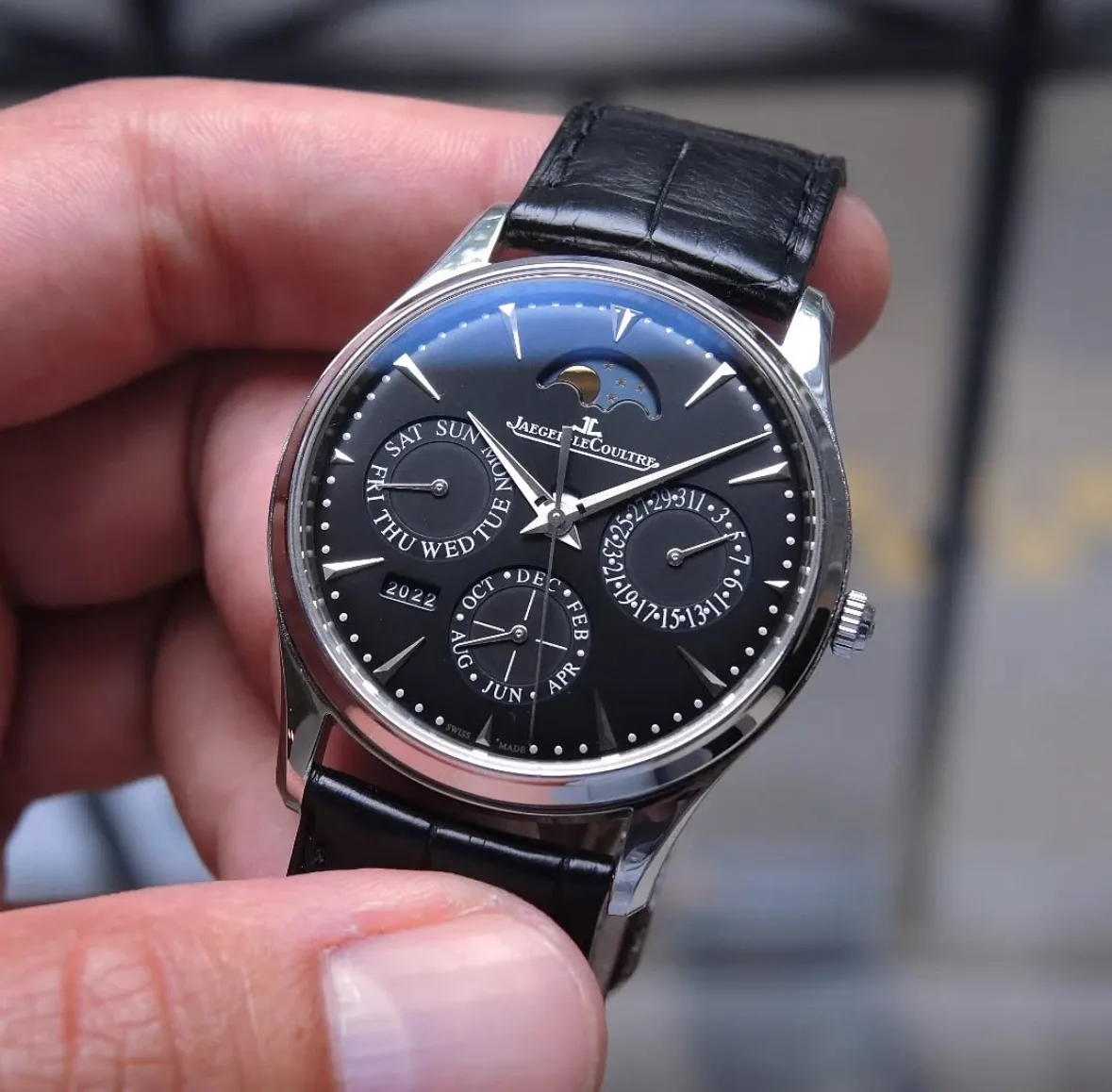
2. Jaeger-LeCoultre Master Ultra Thin Perpetual Q1308470
Pic: Le Collection’Heure
This is the most modern and most wearable perpetual calendar on the list. Released in 2013, the Q1308470 comes in a stainless steel 39mm case, with a thickness of just 9.2mm. That makes it the thinnest full perpetual calendar in its price range, and one of the easiest to wear under a cuff.
The layout is balanced and clean. JLC went for symmetry, with day, date, and month at the traditional tri-compax positions, and moonphase at twelve. The leap year indicator is subtly integrated into the month subdial. It is powered by the JLC calibre 868, a slim automatic movement with solid finishing and a 38-hour power reserve.
The Master Ultra Thin Perpetual was an ambitious move by JLC. Offering a stainless steel perpetual calendar for under £20,000 at retail was almost unheard of at the time. On the secondary market, these regularly show up between £10,000 and £13,000.
Would I wear it? Yes, though with a caveat. This is the only watch on the list that might feel a little too modern and clinical. But on the right strap, it becomes a fantastic daily-wear perpetual calendar.
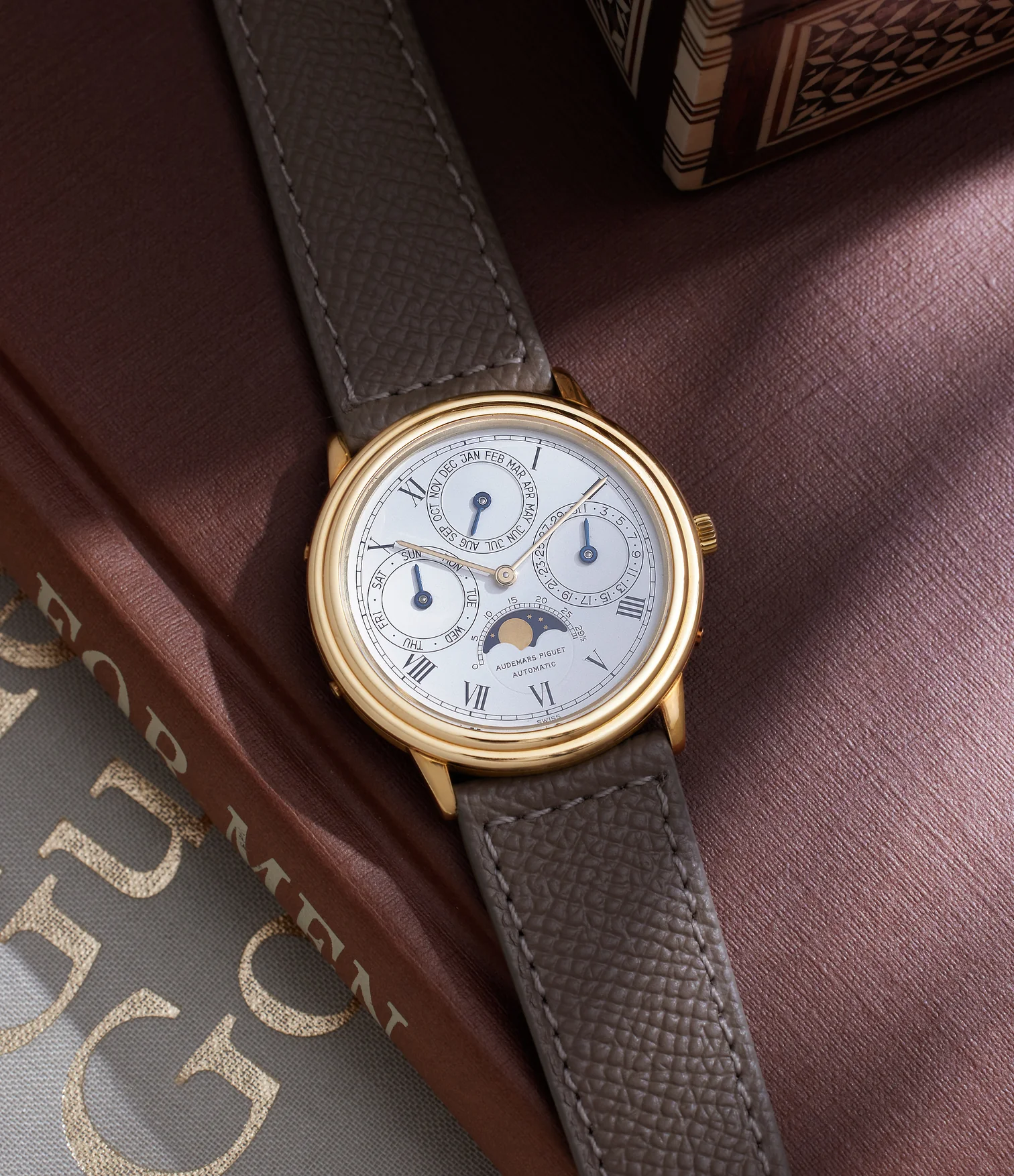
1. Audemars Piguet Quantieme Perpetual Ref. 5548BA
Pic: A Collected Man
Last but not least, a golden oldie. The Audemars Piguet 5548 is a sleeper reference that harks back to a time when AP was still primarily known for ultra-thin complications. This model, produced throughout the 1980s and early 1990s, features a classic 36mm yellow gold case and a beautifully restrained dial with all the calendar functions arranged in textbook symmetry.
Inside is the Jaeger-LeCoultre calibre 2120 with AP’s perpetual calendar module stacked on top. It is the same ultra-thin movement family that powered the Royal Oak Perpetual Calendar and the Vacheron 43031. It ticks away at a leisurely 19,800 vph, with a slim rotor that allows for an overall case thickness of just over 8mm.
The 5548 has aged beautifully. It looks like a vintage Calatrava but carries the mechanical firepower of a modern perpetual. These were expensive when new but are now routinely available for £12,000 to £15,000. You are getting an ultra-thin perpetual calendar from a Holy Trinity brand for the price of a Rolex GMT.
Would I wear it? Without hesitation. It feels like the kind of watch that will quietly become collectible again, once the world tires of skeletonised ceramic sports watches.
Final Thoughts
The perpetual calendar is a fascinating complication. It sits at the intersection of mechanical brilliance and functional absurdity. Nobody needs one. But for a certain kind of collector, that is precisely the point. The idea that a machine built today can know whether it is a leap year in 2096 is just too good to resist.
And contrary to what the market might suggest, you do not need £50,000 and a wrist like The Rock to wear one. There are options out there that are slim, elegant, and reasonably priced. You just have to know where to look.
These five represent the best of that ethos. They are complicated, charming, and perfectly sized for daily wear. More importantly, they remind us that great watchmaking is not always about the flashiest release or the biggest brand. Sometimes, it is about quiet excellence hiding in plain sight.